Varidaic started at a hackathon with Colin Lim and Trevor Yates, but it never felt like a disposable hackathon project. At the time, AI code generation still felt new, Claude Sonnet 3.5 had just landed, and most people were still trying to decide whether these models were actually useful or just a novelty. We went in with a different question: if a model could generate code, reason through concepts, and adapt its output, could it do something better for education than act like a dressed-up chatbot?
The first version came together quickly, but the core idea was already there. Learning should not be linear by default. A system should be able to ask questions, gauge comprehension, notice weak spots, and decide what to do next. If a learner is missing a foundation, it should step back. If they clearly get the concept, it should move them forward.
The idea that stayed
What stuck with me was less the prototype itself and more the learning model behind it. Most educational software still treats knowledge like a fixed sequence: lesson one, then lesson two, then lesson three, whether or not the learner actually understands any of it. Varidaic started from the opposite assumption. Knowledge is connected. Understanding is uneven. Real learning rarely moves in a straight line.
That is why the system thinks in terms of progression rather than content delivery. It is there to guide someone through a domain with enough structure to build understanding over time.
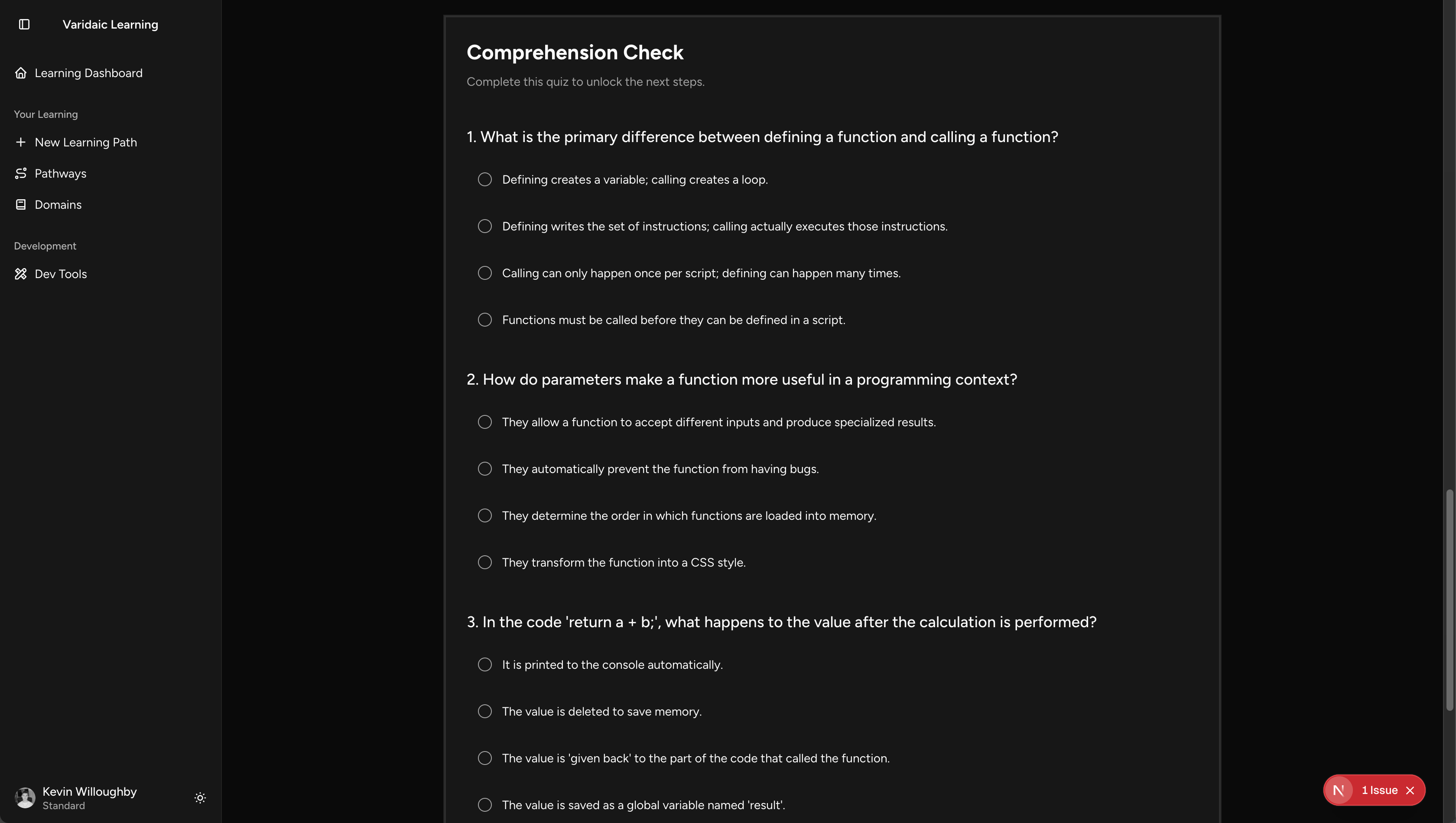
A good tutor does not ask only what comes next. It asks what you actually understand.
From prototype to platform
The current version is much closer to what we originally saw in it. The prototype proved the interaction model. The newer system pushes the learning model further by treating topics as connected ideas inside a larger knowledge graph instead of isolated lessons in a fixed path.
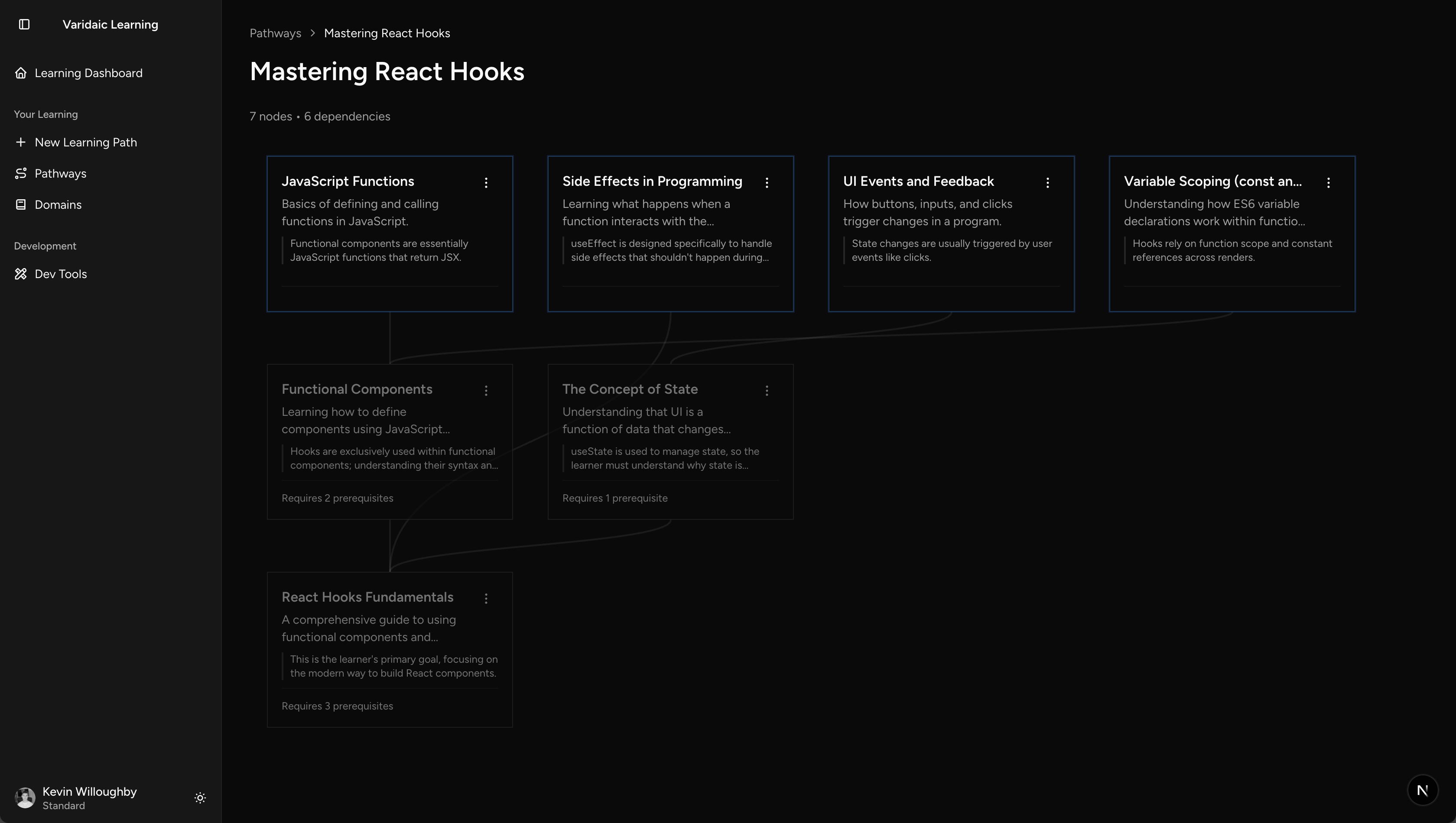
Plenty of products can explain things with AI. Varidaic tries to manage understanding instead. It reacts to gaps, strengths, and momentum as the learner moves so the path behaves more like a tutor and less like a rigid course.
Why it mattered to me
This project relit something for me. The first version came at a moment when AI felt wide open and programming started to feel expansive again. It reminded me that a good idea could still turn into a working system over a weekend, especially with the right people in the room.
Varidaic stuck with me because it was never only about the prototype. It was one of the first projects that made AI-native software feel like a real design space instead of a gimmick factory. The newer version only sharpened that feeling.