PlanPlace exists because agent work is getting longer, and the review trail is still usually a mess. The agent says it made a plan. Somewhere in the transcript, maybe it did. The agent says it ran the tests. Maybe the log is five thousand lines above the final message. The agent says the thing is done, and now the human has to reconstruct what happened from a chat window that was never meant to be a project record.
That bothers me. A plan should not vanish into the same place as the prompt that created it. The questions should not be scattered across a session. The proof should not be an afterthought pasted into the final answer. If an agent is going to do real work, there needs to be somewhere outside the run where the work can hold still.
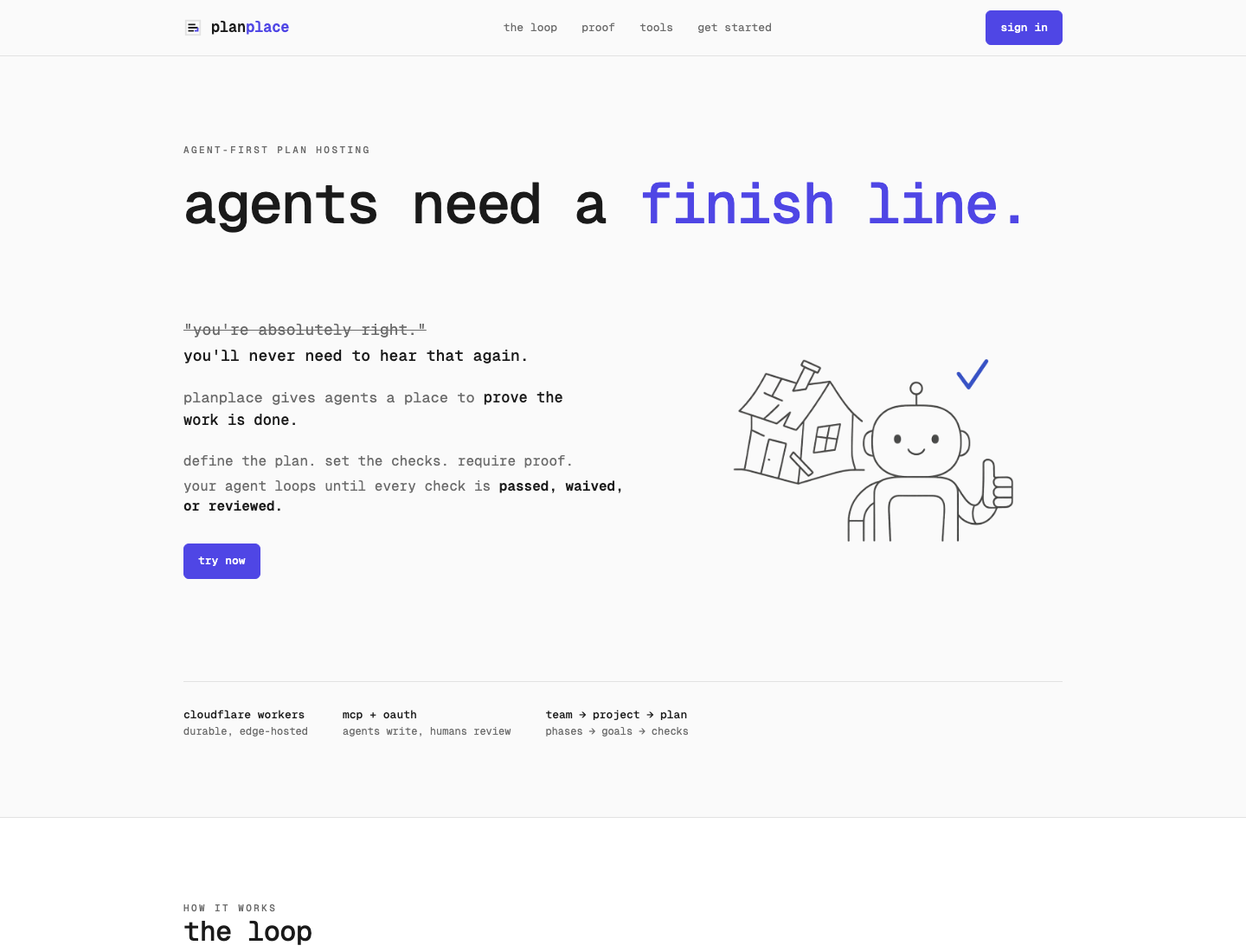
A plan should survive the run
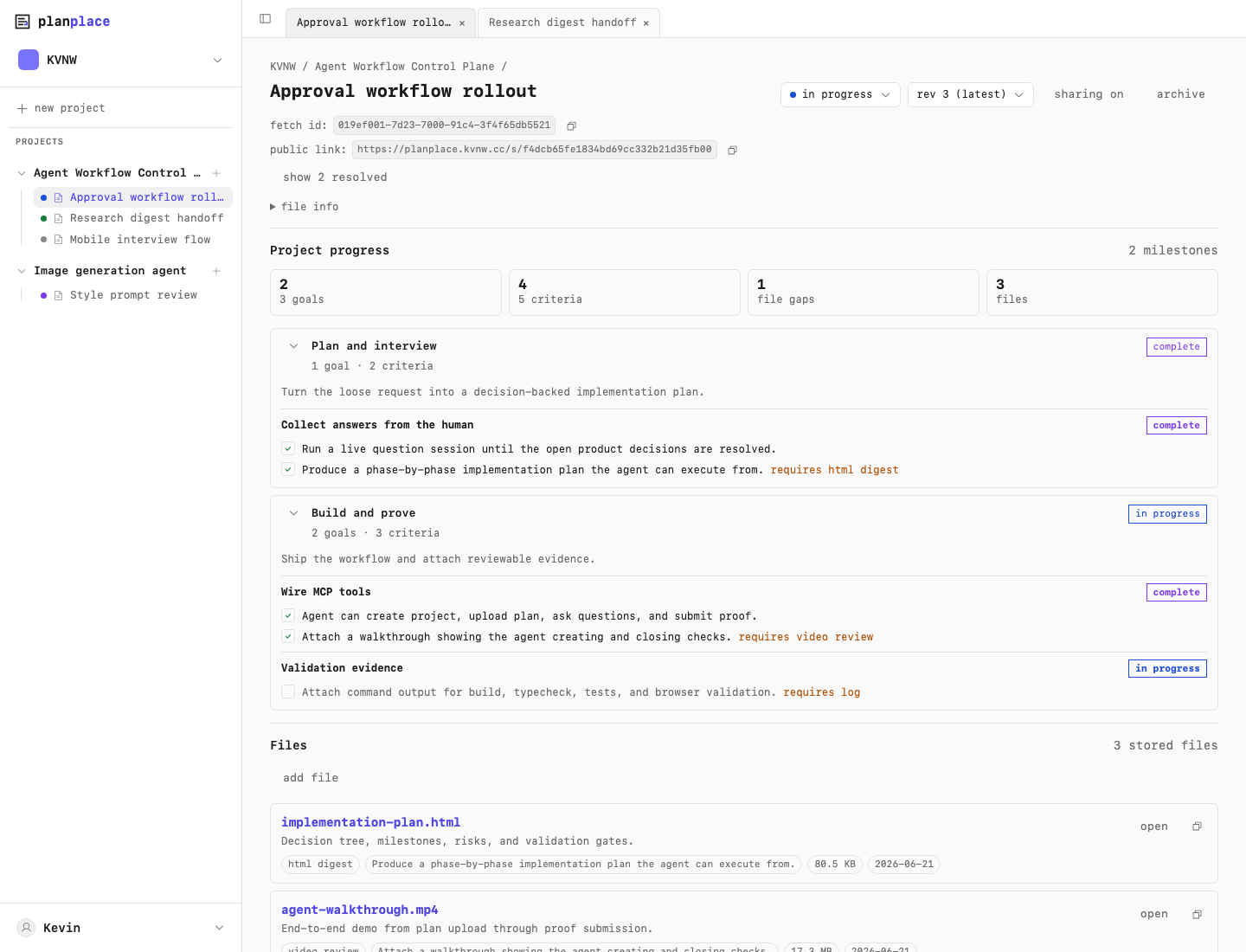
The basic shape is simple. You sign in, add the PlanPlace MCP server to the agent, and the agent can start writing to the app. It can create a project, upload a plan, split the work into phases, add goals, add checks, ask questions, and attach proof.
That sounds like project management software. I do not really think of it that way. PlanPlace is smaller than that. It is more like a place where the agent has to put the receipt. Here is the plan. Here is what "done" means. Here is the file that proves this check passed. Here is the question I asked before I made the call.
The important part is that the plan is not trapped inside the agent's current context window. The terminal can close. The model can restart. A different agent can come along later and fetch the same plan through MCP. The work still has shape.
The proof is part of the work
A lot of agent systems still treat proof like theater. The agent finishes, writes a confident paragraph, maybe lists the commands it claims to have run, and then everyone moves on. That is fine for small things. It breaks down fast once the work has multiple phases or someone else needs to review it later.
In PlanPlace, checks can require files. An MP4 walkthrough of the app. A screenshot. A raw log. An HTML digest that explains what happened. The file is attached to the thing it proves, not thrown into a pile at the end.
The HTML part is the one I keep coming back to. Agents are weirdly good at making small, useful documents. Give them a browser-shaped surface and they can make a research digest, a validation report, a release note, a test summary, whatever the work needs. That is more useful to me than trying to force every possible artifact into a perfect schema too early.
The agent can decide how to explain the work. PlanPlace gives that explanation somewhere to live.
The interview flow matters
The other piece is questions. Planning with an agent usually fails in a boring way: it asks one large question, gets one large answer, and then pretends the ambiguity is gone. That is not how good planning works. Good planning is annoying. It notices a gap, asks about it, changes shape, notices another gap, asks again.
PlanPlace has live question sessions for that. The agent can ask one question at a time and wait for the answer. You can answer from your phone. The agent keeps going until the plan is actually usable, and the questions are stored with the plan instead of disappearing into the chat.
That is a small feature, but it changes the feel of the workflow. The human does not have to babysit a terminal. The agent does not have to guess. The plan gets better because the conversation around it is preserved.
A little state machine for approval
The longer-term idea is that PlanPlace can sit next to any agent loop that needs human approval. Spectre can use it. Codex can use it. Claude can use it. Some custom internal system can use it. The app does not need to own the whole workflow. It only needs to own the part where work becomes reviewable.
That is why MCP is the right interface. The agent is not scraping a UI or pretending to be a user. It has tools. It can create the project, write the plan, update the state, ask the question, upload the proof, and come back for the result. The human still reviews the important parts.
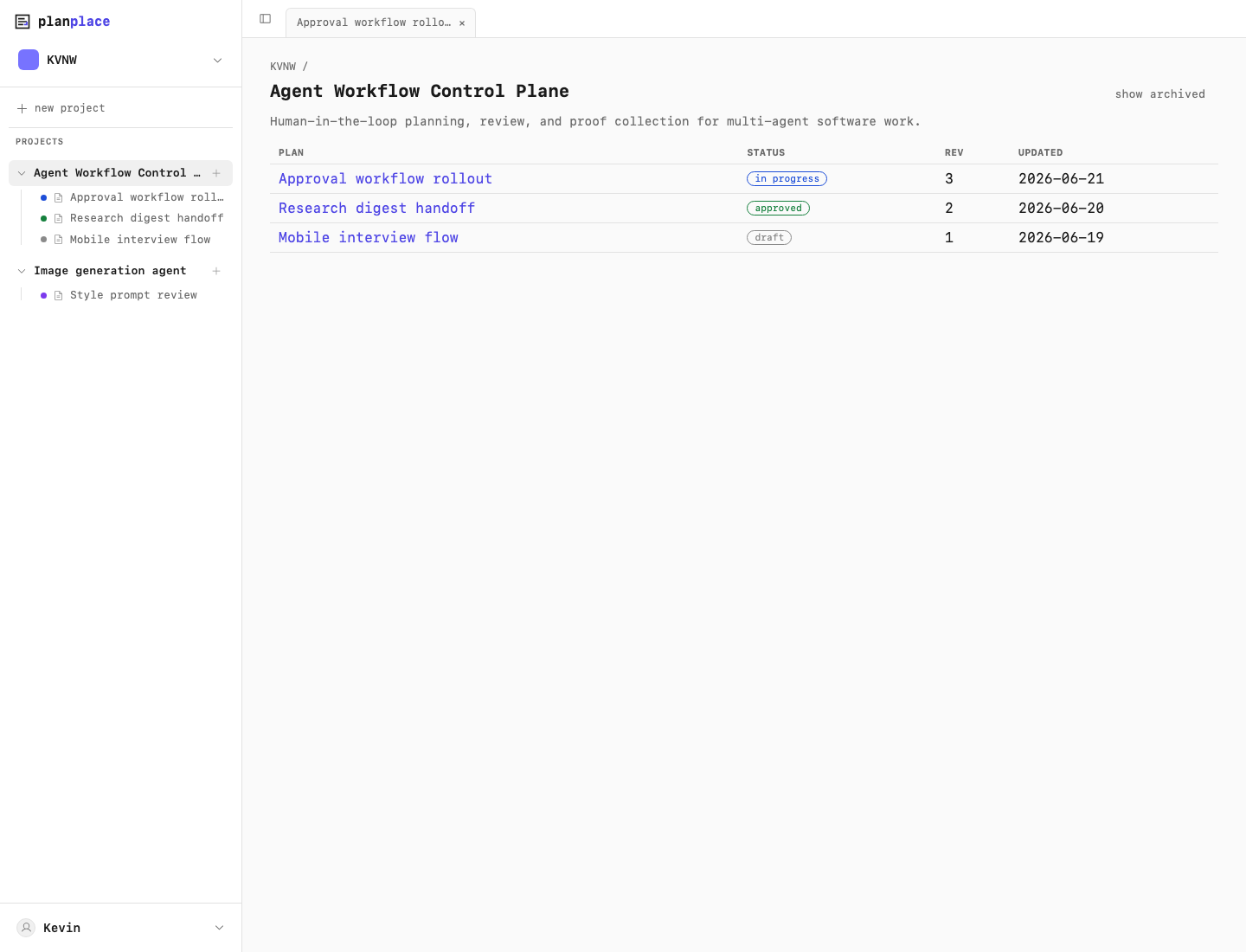
I built PlanPlace because I kept wanting to give agents more work, but not more unearned trust. If something has been running for an hour while I was somewhere else, I do not want a confident final message. I want the plan it followed, the questions it asked, the checks it closed, and the files it left behind.
Without that, everything starts to feel like vibes again. And I am tired of vibes.